Quick Summary
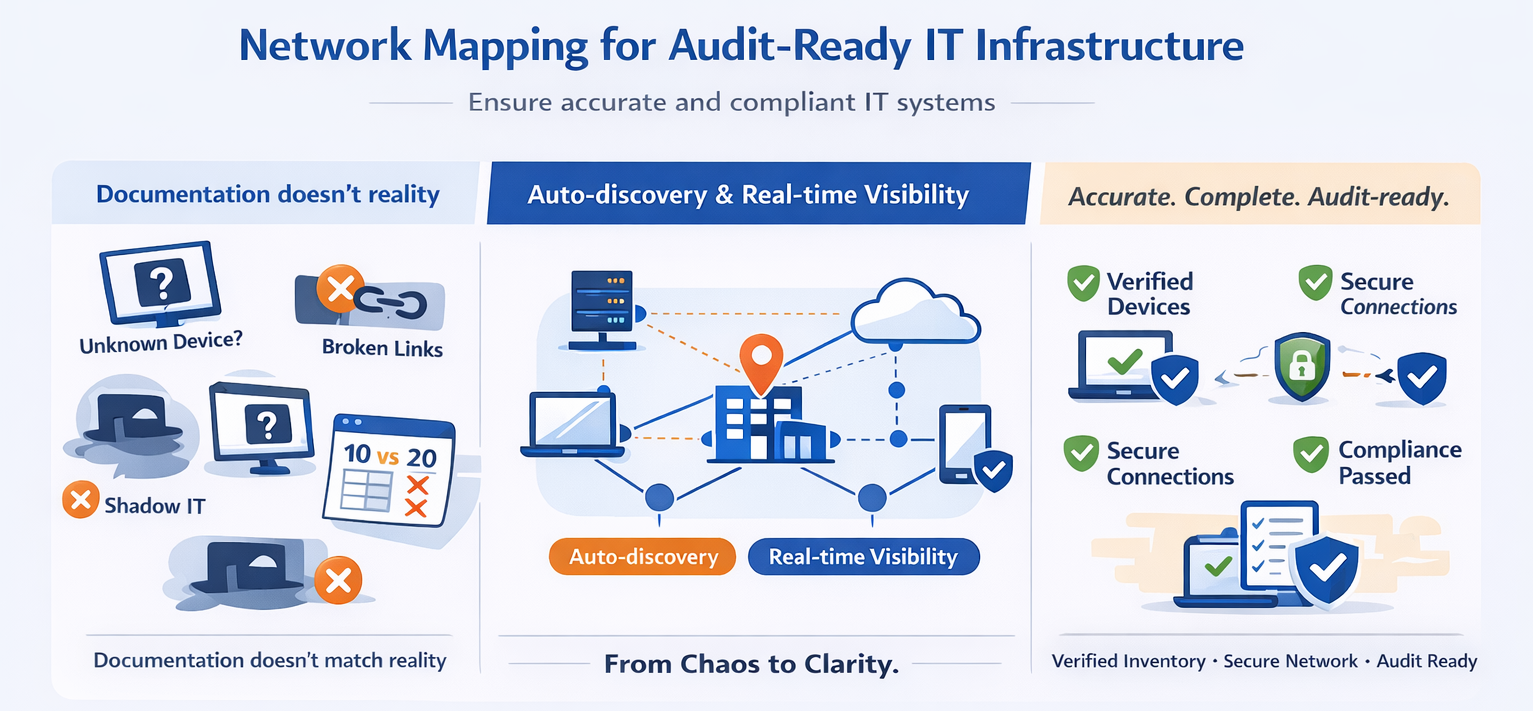
Most IT audits fail not because teams are careless, but because documentation does not match reality. Network mapping software closes that gap by auto-discovering real infrastructure. IT Portal turns those maps into structured, searchable, audit-ready documentation - without relying on spreadsheets or tribal knowledge.
IT infrastructure has never been harder to document - and auditors have never been better at finding what is missing. In 2026, the average enterprise manages assets across on-premises data centres, multi-cloud environments spanning AWS, Azure, GCP, and OCI, remote workforce endpoints, and edge deployments - all changing faster than any manual process can track. The result is a documentation gap that has become the leading cause of audit findings: your team's records show one environment; reality shows another.
Network mapping software solves this by continuously auto-discovering every device, dependency, and communication path across your entire hybrid estate - no spreadsheets, no tribal knowledge, no surprises. When paired with a structured IT documentation platform like IT Portal, those real-time maps become the audit-ready evidence trail that compliance frameworks including SOC 2, ISO 27001, PCI DSS, HIPAA, and CMMC 2.0 specifically require. This guide walks through exactly how to build that system - and why MSPs who do it cut audit prep time from weeks to hours.
What Is Network Mapping Software?
Network mapping software automatically discovers, visualises, and tracks your IT infrastructure in real time. It scans your environment, identifies every device, and shows how they connect - producing a complete, always-current picture of your network topology, dependencies, and communication paths.
For audits, it answers four critical questions every compliance reviewer will ask:
- What devices exist on the network?
- Where are they located - on-premises, cloud, or remote?
- How are they connected and what depends on what?
- Which systems handle sensitive or regulated data?
How Network Infrastructure Mapping Improves Documentation Accuracy
Network mapping tools eliminate human memory and manual updates from the equation. Here are the key improvements in terms of documentation accuracy.
Always-Current Diagrams
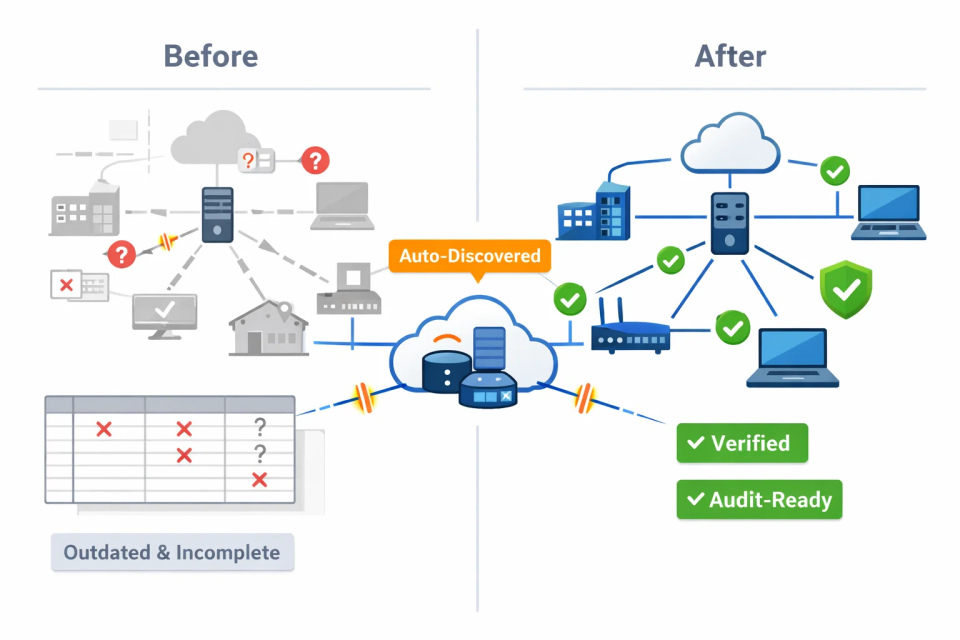
New server deployed in AWS? New switch added on-premises? The map updates without human intervention. For MSPs managing multiple clients, this eliminates the manual update backlog that causes documentation to drift from reality.
Real-Time IT Infrastructure Mapping Without Agents
Modern tools support agentless discovery using read-only SNMP polling, cloud API connections, SSH, and WMI – delivering near-complete hybrid visibility without touching individual endpoints. This is critical for environments with strict change control or high device counts.
Relationship & Dependency Tracking
This reduces audit surprises and helps you identify the dependencies of applications on databases, services on network segments, and communication systems with external resources. Applications, databases, identity services are all clearly linked.
Rogue and Unknown Device Detection
Every network has devices that should not be there. Network mapping finds them before auditors do. When integrated with IT Portal, unknown device discoveries feed directly into documented investigation and resolution workflows - turning a compliance risk into evidence of controlled security management.
Compliance Frameworks That Require Network Mapping
- SOC 2: Requires documented knowledge of which systems process customer data.
- ISO 27001: Mandates asset inventories and information flow diagrams.
- HIPAA: Requires documentation of all systems handling protected health information.
- PCI DSS: Requires network segmentation diagrams showing the cardholder data environment.
- CMMC 2.0: Under final rules effective since late 2024, comprehensive asset management and CUI flow documentation is mandatory for Level 2 and Level 3 certification.
Step-by-Step: Using Network Mapping Software to Prepare for an Audit
- Discover every asset: Use SNMP, WMI, SSH, and cloud APIs across all environments. Agentless methods cover endpoints where agents cannot be deployed. Goal: zero blind spots.
- Close hybrid and remote gaps: Enable cloud API access for all in-scope platforms. Deploy scanners at remote sites. Validate VPN discovery paths. Document what each scanner covers - this gap documentation itself demonstrates controlled change management.
- Validate and classify assets: Assign roles, owners, and audit-relevant flags. Classify by site, rack, and device for physical traceability.
- Map communication paths and dependencies: Document server-to-database flows, identity service dependencies, external connections, and segmentation boundaries - essential for PCI DSS and CMMC 2.0 validation.
- Maintain a continuous audit trail: Schedule regular scans and log every infrastructure change with a timestamp and owner. Auditors check that changes were controlled - not just that the current state is documented.
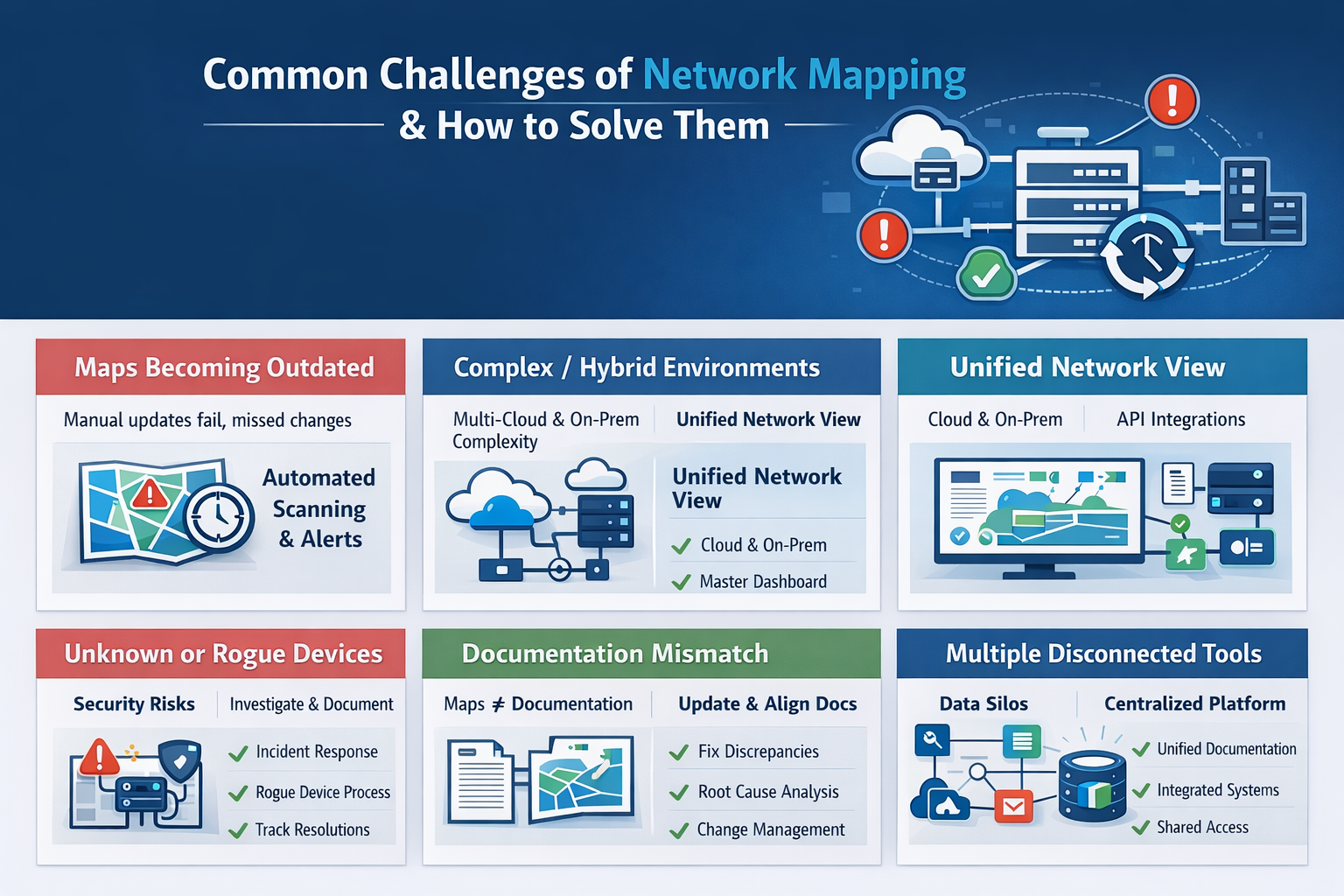
Common Challenges of Network Mapping and How to Solve Them
Here are some common challenges of network mapping and their solutions.
-
Maps Becoming Outdated: Manual updates fail and employees may miss on crucial information.
-
Solution: Schedule automated scanning, such as daily scans for critical environments, and weekly for stable infrastructure. Configure IT Portal integrations to pull updated data automatically. Set alerts for when maps haven't been refreshed on schedule.
-
Complex or Hybrid Environments: Multi-cloud plus on-premises creates scanning complexity.
-
Solution: Use mapping tools with cloud API integrations. Deploy scanning agents in each environment. Create a master view in the network mapping tool that consolidates all sources. Document what each scanner covers so nothing falls through gaps.
-
Unknown or Rogue Devices: Every network has them.
-
Solution: Treat unknown devices as security incidents. Investigate immediately. Document your process for handling rogue device discovery. Use the software to track investigations and resolutions. This turns a compliance problem into documented security management.
-
Documentation Mismatch: Maps show one thing, documentation says another.
-
Solution: Update your IT operations documentation to match reality, then investigate why the mismatch occurred. Fix the root cause, such as inadequate change management.
-
Using Multiple Tools: Different tools for discovery, documentation, ticketing, and monitoring create information silos.
-
Solution: Centralize documentation in the software so it can be referenced by network mapping tools, ticketing systems, and monitoring alerts, and so on.
Why IT Portal Complements Your Network Mapping Tool
Network mapping tools identify and visualise devices. Without a structured documentation system, MSPs cannot turn those maps into standardised, repeatable, audit-ready processes. IT Portal bridges that gap in four ways:
- Converts maps into structured, searchable records: Devices, sites, cabinets, and dependencies become organised entities auditors can trace to a single source.
- Maintains long-term documentation governance: Maps show the current state. IT Portal maintains historical records, change logs, and approval trails alongside them.
- Eliminates tool sprawl: In 2026, the MSP pain point is not spreadsheets - it is discovery data in the RMM, tickets in the PSA, and configurations in a CMDB that never sync. IT Portal serves as the single source of truth all other tools reference.
- Accelerates engineer onboarding: New team members see infrastructure topology in IT Portal and drill into device configurations, contacts, and procedures immediately - no tribal knowledge required.
Get started with IT Portal today - 90-day money-back guarantee.
FAQ Section
Agentless auto-discovery, real-time hybrid and multi-cloud visibility, dependency mapping, rogue device detection, and integration with documentation platforms. The most reliable tools produce structured output that feeds directly into audit evidence workflows.
Tools that combine agentless discovery, multi-cloud coverage across AWS, Azure, GCP, and OCI, and direct integration with IT documentation platforms. IT Portal works alongside leading mapping tools to convert topology data into compliance-mapped records. Prioritise tools with continuous change logging - auditors expect documented trails, not just point-in-time snapshots.
Yes. It identifies rogue devices, unencrypted communication paths, segmentation gaps, and unexpected external connections - and when integrated with IT Portal, those findings feed into documented security incident workflows.
Not explicitly by name, but practically essential. SOC 2, ISO 27001, HIPAA, PCI DSS, and CMMC 2.0 all require asset inventories and data flow documentation that manual methods consistently fail to maintain at audit time.
Yes. MSPs using continuous network mapping with centralised documentation report reducing audit prep time significantly. Instead of assembling evidence under deadline pressure, they maintain continuously updated records as part of normal operations.
By documenting system dependencies and communication paths, enabling accurate recovery sequence definition. IT Portal stores these dependency maps alongside DR runbooks, keeping recovery documentation aligned with actual infrastructure.
Ready to Eliminate Audit Surprises?
IT Portal provides the documentation governance layer that turns network maps into audit-ready infrastructure. For MSPs managing multiple clients, this is the difference between scrambling at audit time and passing without findings.
Learn how to build documentation systems that stay accurate even as your infrastructure changes.