What you'll gain from this post
A practical understanding of virtual CIO services - when they matter, how they work at scale, and how to get real value from them.
You'll leave with actionable steps, an evaluation checklist, and a clear picture of why structured IT documentation is the foundation that makes any vCIO engagement succeed.
Most IT teams operate without a clear strategy. Support is reactive, budgets are guesswork, and technology decisions get made in isolation from business goals.
That works - until it doesn't. And for growing businesses, the breaking point usually arrives faster than expected.
Virtual CIO services exist to close this gap. They bring executive-level IT leadership to businesses that need strategic direction without the cost or commitment of a full-time hire.
This guide covers what a vCIO does, how they work alongside MSPs, what to look for in a provider, and how to get real value from the engagement.
What are Virtual CIO (vCIO) Services?
Virtual CIO services are outsourced, part-time strategic IT leadership delivered by an experienced professional or team. A vCIO acts as your Chief Information Officer on a flexible, contractual basis - typically a monthly retainer or project-based arrangement - without becoming a full-time employee.
What does a vCIO do?
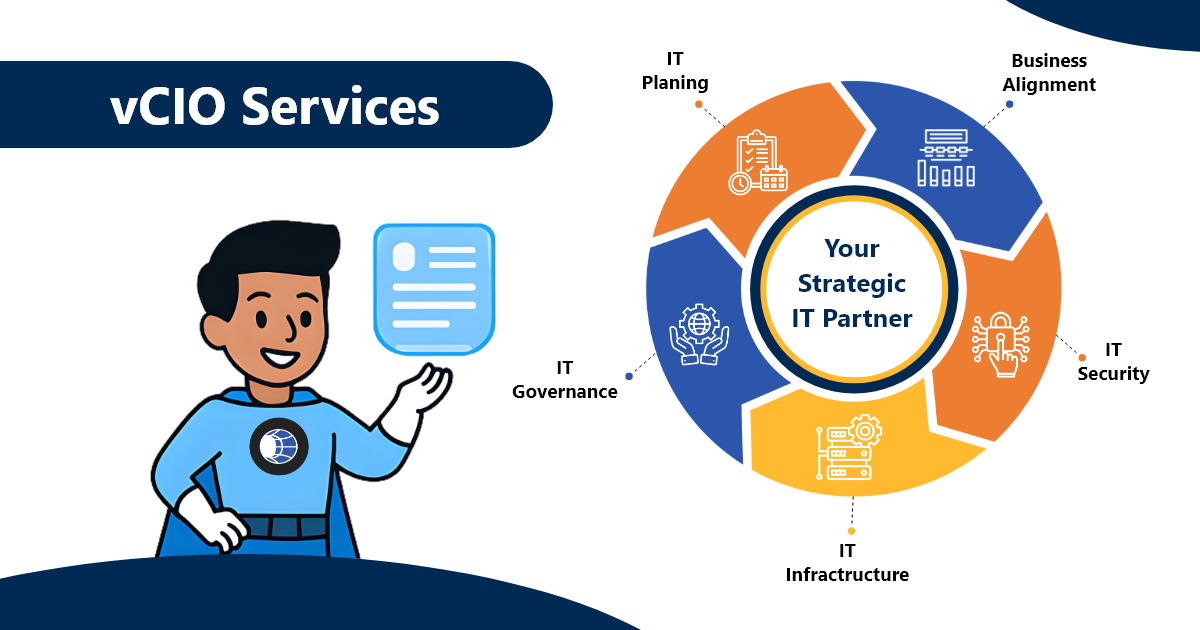
A vCIO operates at the strategic layer, not the operational one. Here's what that looks like in practice:
- IT Roadmapping: Builds 12–36 month technology plans tied to business growth targets, not just infrastructure refresh cycles.
- Budget Alignment: Maps IT spend to revenue goals, eliminates redundant costs, and builds defensible cases for technology investment.
- Tech Stack Standardization: For MSPs managing multiple clients, a vCIO standardizes tooling and processes across the portfolio to reduce complexity and improve margins.
- Risk & Compliance Oversight: Identifies security gaps, manages regulatory requirements (SOC 2, HIPAA, ISO 27001), and builds frameworks that scale.
- Vendor & Stakeholder Management: Negotiates contracts, evaluates new tools, and ensures the technology ecosystem supports - rather than slows - growth.
- Quarterly Business Reviews (QBRs): Presents KPIs, roadmap progress, and strategic recommendations to leadership on a regular cadence.
vCIO meaning in MSP context
For managed service providers, a vCIO is the strategic layer offered alongside tactical MSP services. It allows MSPs to move beyond break-fix or monitoring roles and into trusted advisor status - guiding clients on long-term IT decisions while the MSP handles execution.
This shift matters most when managing multi-client environments or serving businesses with 50+ users across multiple locations. At that scale, reactive support alone is not a sustainable model.
vCIO vs Traditional CIO vs IT Manager
Here's a quick comparison between Virtual CIO, Traditional CIO, and IT Manager:
| Role | Focus | Employment Model | Best For | Typical Cost Structure |
|---|---|---|---|---|
| Traditional CIO | Full strategic + operational leadership | Full-time employee | Large enterprises | $200K–$400K+ salary + benefits |
| Virtual CIO (vCIO) | Strategic planning & oversight | Contract / fractional | SMBs, growing companies, MSPs | Monthly retainer or project-based |
| IT Manager | Day-to-day operations | Full-time or MSP-provided | Tactical execution | Lower operational cost |
When to choose a vCIO over a full-time CIO
Choose a vCIO when you need executive-level strategy but don't have the budget or need for a full-time hire. IT managers handle execution; vCIOs focus on the bigger picture.
Key Benefits of Virtual CIO Services
- Cost-effective leadership: Executive IT strategy at 60–80% less than a full-time CIO hire.
- Faster, better decisions: Data-backed guidance replaces gut-feel IT choices.
- Scalable IT direction: Strategy grows as your business grows - without adding headcount.
- Reduced security risk: Proactive oversight catches gaps before they become incidents.
- Stronger ROI on technology: Every investment is evaluated against business impact, not just technical specs.
How vCIO Services Work (Step-by-Step)
Step 1 - Discovery & Assessment:
Business goals review, IT infrastructure audit, stakeholder interviews, and documentation gap analysis. This stage establishes the baseline state of all systems and surfaces the gaps that strategic planning needs to address.
Step 2 - Strategy Development:
12–36 month roadmap creation, budget planning, and prioritization aligned to growth milestones.
Step 3 - Implementation & Execution:
Coordination with internal teams or MSP, vendor management, and rollout oversight.
Step 4 - Ongoing Optimization:
Continuous monitoring, regular QBRs, and strategy refinement as business needs evolve.
vCIO Services in MSP: How They Work Together
MSPs and vCIOs are not the same thing, and they are not interchangeable. They are complementary.
- MSPs focus on tactical support and daily operations - keeping infrastructure running, resolving tickets, monitoring networks.
- vCIOs focus on long-term strategy and business alignment - deciding where the business needs to go and what technology investments will get it there.
MSPs keep the lights on. vCIOs make sure the lights are pointed in the right direction.
Signs Your Business Needs vCIO Services
- No clear IT strategy or long-term technology plan
- Frequent IT issues or unplanned downtime
- Rising IT costs without measurable ROI
- Compliance or security gaps you don't know how to close
- Rapid business growth with IT that can't keep pace
Companies with 20-500 employees typically benefit most. You're large enough to need strategic IT leadership but not large enough to justify a full-time CIO salary.
Real-World Results from vCIO Engagements
Digital transformation in manufacturing: A manufacturer replaced legacy on-prem systems with a cloud-first environment under vCIO guidance, reducing operational delays by 40%. The vCIO built a 3-year roadmap that aligned every technology investment with revenue goals.
IT cost efficiency in professional services: A mid-sized law firm eliminated $180K in redundant software licenses and unnecessary hardware after a vCIO-led audit. A healthcare provider cut annual IT costs by 28% after the vCIO renegotiated vendor contracts and right-sized cloud spend.
Cybersecurity posture in financial services: A financial services firm passed their first SOC 2 audit on the first attempt under vCIO oversight. Targeted employee training reduced successful phishing attacks by more than 70% within six months.
Scaling for growth: A SaaS startup scaled from 15 to 150 employees with IT aligned to rapid expansion through vCIO roadmapping and governance. An MSP client doubled recurring revenue after shifting from break-fix support to proactive, strategic managed services.
Industries That Benefit from Virtual CIO Services
- Small and Medium Businesses (SMBs)
- Healthcare
- Finance and Legal
- Manufacturing
- SaaS and Technology Companies
vCIO Services Pricing
Virtual CIO services typically range from $2,000 to $10,000+ per month, depending on company size, IT complexity, and engagement scope. Common models include monthly retainers, tiered packages, and custom enterprise pricing.
Factors that influence cost: company size, number of locations, IT complexity, and regulatory requirements.
This is 60–80% less than hiring a full-time CIO while providing the same level of executive-level strategic expertise.
How to Choose the Right Virtual CIO Service Provider
Key evaluation criteria
- Industry experience
- Strategic expertise
- Communication and reporting
- Tool stack and integrations
Questions to ask before hiring
- How do you measure success and report progress?
- What does your engagement process look like?
- How do you work with existing MSPs or internal teams?
Red flags to avoid
- Vague deliverables or lack of measurable KPIs
- Overdependence on the provider without knowledge transfer
- Misalignment of expectations from the start
How IT Portal Supports the vCIO Model
A vCIO engagement is only as effective as the information available to act on. That's where centralized IT documentation becomes a genuine advantage - not a nice-to-have.
IT Portal provides the structured, searchable record of every asset, configuration, contact, password, and procedure that a vCIO needs to advise confidently and an MSP needs to execute efficiently.
When IT environments are fully documented in IT Portal:
- Any vCIO can step into a client environment and advise immediately - no lengthy knowledge transfer required.
- QBR presentations and compliance reviews are backed by documented evidence, not memory or spreadsheets.
- As clients grow from 50 to 200 users or expand to new locations, the documentation grows with them.
"Virtual CIO services deliver up to 3× greater strategic impact when every roadmap decision and investment is grounded in clean, structured documentation."
The Bottom Line
Virtual CIO services give growing businesses and MSPs access to executive-level IT strategy - without the full-time cost, without the overhead, and without waiting until complexity forces the issue.
The organizations that get the most from a vCIO engagement are the ones that come prepared: with clear goals, defined KPIs, and a documented picture of their IT environment.
Ready to build an IT strategy that actually scales?
See how hierarchical documentation and audit-ready records make any vCIO engagement far more successful.
Frequently Asked Questions (FAQs)
A vCIO provides strategic IT leadership and long-term planning. An MSP handles day-to-day technical operations and support. The vCIO decides what to do; the MSP executes how to do it. Many businesses benefit from both working together.
A vCIO provides ongoing strategic leadership as part of your extended executive team. IT consultants typically work on specific projects with defined end dates. vCIOs focus on continuous alignment between business goals and technology - not just solving isolated problems.
Companies with 20–500 employees typically benefit most. Fast-growing startups and MSPs serving multiple clients also see significant value.
Yes - and this is often the ideal setup. A vCIO provides strategic direction while your team or MSP handles execution. Everyone works toward aligned business objectives rather than just keeping systems running.
Most organizations see initial strategic improvements within 30-60 days (cost optimizations, risk identification, roadmap clarity). Deeper outcomes like security improvements or digital transformation typically materialize within 6–12 months.