Treating every client as a unique custom project feels client-friendly - until it quietly destroys your margins, burns out your team, and stops you from scaling. MSPs standardize operations to break free from this cycle.
Mature MSPs can support more endpoints per technician because their operations are built on repeatable standards, not one-off processes.
This blog offers a practical, tactical framework to standardize operations across all your clients, backed by the financial case, real implementation steps, and a 90-day roadmap. You'll learn how to reduce chaos, scale profitably, and make standardization a competitive advantage.
What Does MSP Standardization Mean?
MSP standardization is the practice of delivering services through consistent tools, processes, security policies, documentation standards, and operating procedures across every client environment. The goal is to reduce complexity, improve scalability, and increase profitability.
The financial case is compelling:
- Standardized processes allow labor to scale more slowly than revenue.
- A manage-by-exception model can significantly reduce routine ticket volume.
- Key metrics improve across the board: technician utilization, EBITDA margins, and revenue per endpoint.
Without standardization, every new client becomes a custom project that drains efficiency and profitability.
Before standardization: Every client has a different password process, documentation layout, and escalation path. Technicians spend time hunting for credentials, guessing SOP locations, and rebuilding context from scratch on every ticket.
After standardization: Every technician knows exactly where to find credentials, SOPs, asset records, and client exceptions. Onboarding is faster, resolution times drop, and senior staff spend less time answering basic questions.
Build Your Standardization Framework
Start by defining a golden baseline - the non-negotiable standards every client receives:
- Security, identity, endpoint management, backup, and documentation.
- A standard client environment template that defines the required tools, documentation structure, security settings, and support processes.
Create a tiered service architecture:
- Tier 1: Universal baseline for all clients.
- Tier 2: Industry-specific additions.
- Tier 3: Approved exceptions only.
Use standardized policies and documentation to reduce manual effort and keep environments consistent, leveraging integrations where possible.
The Six Operational Pillars
1. Standardize your tech stack
Choose one vendor per category: RMM, PSA, EDR, backup, and documentation. This eliminates tool sprawl and simplifies training.
2. Enforce security baselines
Adopt CIS Benchmarks as your reference standard. Define clear security controls for every managed environment and establish a process for identifying and flagging configuration drift so it can be reviewed and addressed consistently.
3. Systematize client onboarding
Define clear Day 1 / Day 30 / Day 90 milestones. Make time-to-productive your key metric. A structured onboarding process ensures every client starts with a clean, documented environment that follows your baseline.
4. Standardize ticket and escalation workflows
Implement consistent L1/L2/L3 routing rules that don't depend on tribal knowledge. When your escalation path is documented and predictable, resolution times improve and senior technicians aren't constantly pulled into issues that could be handled at L1.
5. Standardize reporting and QBRs
Use the same report structure for every client: security score, SLA performance, exceptions, and roadmap. Consistent QBR formats make it easier to prepare, compare performance across clients, and present a professional service story.
6. Standardize Documentation
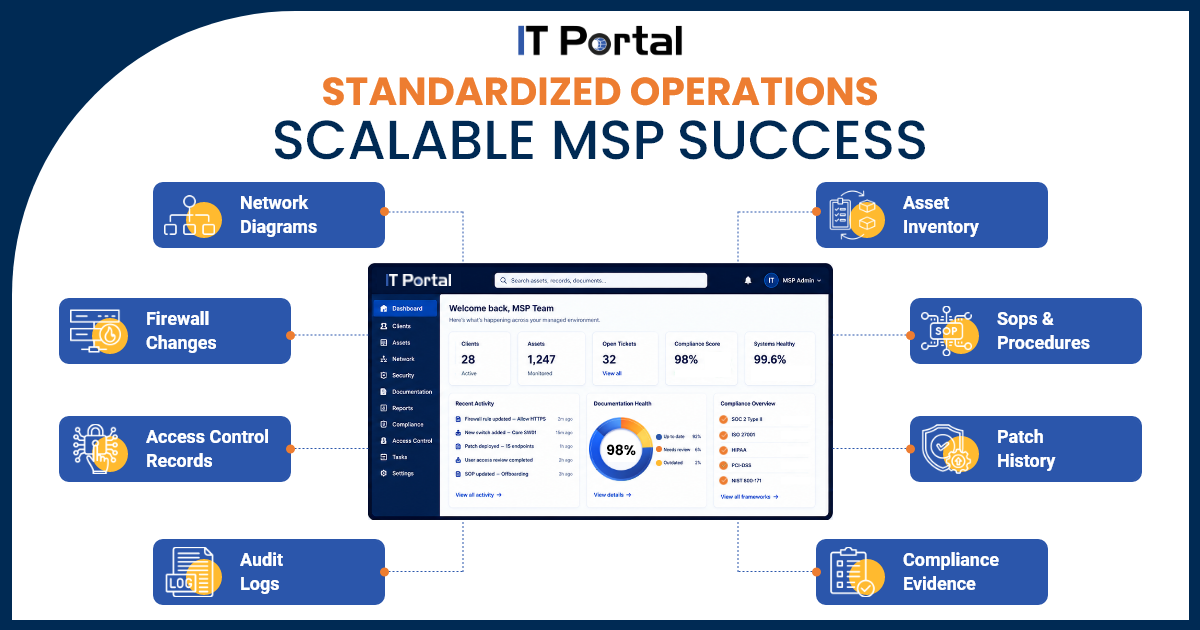
Documentation is the connective tissue of your entire operation. Every client should follow the same structure - and a documentation platform like IT Portal helps MSPs apply that structure consistently across all client records, assets, credentials, SOPs, and exceptions.
Standardized documentation:
- Reduces technician dependency
- Accelerates onboarding
- Improves ticket resolution times
- Simplifies audits and compliance reviews
- Supports consistent service delivery at scale
Handling Client Pushback
Resistance is normal. Clients often cite retraining costs, legacy attachments, or fear of losing control.
Translate standardization into client language: emphasize improved uptime, stronger security, and lower long-term costs. Most clients respond positively when they understand that standardization protects them, not just your margins.
Use a manage-by-exception contract clause with a clear approval process, regular review cycles, and an exit path for persistently non-compliant clients.
Measuring Whether Standardization Is Working
Many mature MSPs track targets such as technician utilization, active exceptions, onboarding time, and tickets per endpoint to measure operational consistency. Specific benchmarks will vary by MSP size, client mix, and service model - but the direction of travel should always be toward fewer exceptions, faster onboarding, and lower ticket volume per endpoint.
Key metrics to track:
- Active exceptions count
- Time-to-onboard new clients
- Tickets per endpoint
- Drift incidents
Conduct a quarterly exception audit: reapprove, remediate, or retire each exception. This keeps your baseline clean and prevents one-off approvals from becoming permanent workarounds.
What Good MSP Standardization Looks Like
While every MSP is different, mature service providers often aim for operational targets such as:
- Technician utilization in a healthy range that avoids both underuse and burnout
- A small and shrinking number of active client exceptions
- New client onboarding completed within a clearly defined window
- Consistent security baseline across all managed environments
- Quarterly exception reviews built into standard operations
- Standardized documentation across every client via a single platform
Getting Your Team on Board
Top-down mandates rarely stick. Involve senior technicians as standard champions who help design, test, and communicate standards to the rest of the team.
- Faster new-hire onboarding becomes visible proof that your standards are mature.
- Celebrate wins publicly - when a standard prevents an incident, share the story.
- Frame standardization as making everyone's job easier, not adding bureaucracy.
Common Standardization Mistakes MSPs Make
- Standardizing tools without standardizing processes
- Allowing unlimited client exceptions
- Skipping documentation standards
- Measuring activity instead of outcomes
- Rolling out changes without technician buy-in
Your 90-Day Implementation Roadmap
Month 1 - Audit and Define: Inventory all environments, document every informal exception, and define the golden baseline.
Month 2 - Build and Pilot: Write SOPs, deploy to 2-3 easy-win clients, and set up drift detection.
Month 3 - Roll Out and Measure: Communicate to all clients, track standardization KPIs, and run your first exception audit.
Conclusion
Standardization turns MSP growth from a constant operational strain into a repeatable service model. When tools, workflows, documentation, and exceptions follow the same structure, teams work faster, onboard clients more smoothly, and deliver more consistent service.
The MSPs that scale without chaos are the ones that stopped treating every client as a custom project and started delivering a consistent, documented, and measurable service experience.
See how IT Portal helps MSPs create repeatable documentation standards across every client environment.
Frequently Asked Questions
To reduce complexity, improve technician efficiency, increase profitability, and scale service delivery consistently.
Most MSPs start with security controls, endpoint management, documentation, backup solutions, and ticket workflows.
A model where all clients follow a standard baseline and deviations require approval and ongoing review.
Track onboarding time, active exceptions, technician utilization, ticket volume, and drift incidents.
Yes. Most successful MSPs use a standard baseline with approved exceptions for unique business requirements.