The audit notice arrives.
You have 48 hours to produce 12 months of access logs, system configurations, and documentation.
And your team doesn't know where half of it is.
For healthcare IT teams, compliance pressure is constant. Regulators are stricter. Auditors are more thorough.
And the cost of a compliance failure - financial penalties, reputational damage, operational disruption - is higher than ever.
According to Gartner, organizations without structured IT documentation face significantly longer audit cycles and higher remediation costs.
"Most healthcare IT teams aren't non-compliant — they're unprovable."
The uncomfortable reality is this: healthcare IT compliance isn't just about having the right policies on paper.
It's about having the systems, controls, and documentation to prove that everything is working as expected - at any point in time.
This guide covers healthcare IT compliance requirements, why most teams struggle, and how structured IT documentation for healthcare turns it into a controlled, ongoing process.
What Is Healthcare IT Compliance?
Healthcare IT compliance refers to the set of regulations, standards, and internal controls that govern how healthcare organizations manage their technology infrastructure.
Most people associate compliance with HIPAA and protected health information (PHI). However, it's only part of the picture. Healthcare IT compliance also covers:
- IT infrastructure management: Servers, networks, hardware, and software systems.
- Access control policies: Who can access what, and under what conditions.
- Data handling and encryption: How patient and operational data is stored and transmitted.
- System change management: Tracking configuration changes and updates.
- IT process documentation: SOPs, runbooks, and operational records.
IT compliance for healthcare isn't just about protecting patient data. It's about demonstrating that your entire IT operation is structured, controlled, and accountable.
Key Healthcare IT Compliance Requirements
HIPAA Security Rule
The HIPAA Security Rule sets the baseline for healthcare IT compliance by requiring administrative, physical, and technical safeguards to protect electronic PHI (ePHI).
From an IT perspective, this means:
- Data protection controls: Preventing unauthorized access to patient data.
- Access management: Ensuring only authorized personnel can view or modify ePHI.
- Risk analysis and management: Identifying and mitigating IT security risks.
- Incident response procedures: Documented plans for security events.
Access Control & Identity Management
Controlling who has access to what is one of the most scrutinized areas during audits.
Healthcare IT compliance requires:
- Role-based access control (RBAC): Users can only access systems and data relevant to their role.
- Least privilege principles: No user has more access than necessary.
- Access reviews: Periodic audits of user permissions to catch outdated or excessive access.
- Privileged account management: Strict controls on administrative credentials.
Audit Logs & Monitoring
Regulators and auditors expect healthcare IT environments to maintain comprehensive logs.
Requirements include:
- User activity tracking: Who logged in, when, and what they accessed or changed.
- System change logs: Records of configuration changes, updates, and patches.
- Access attempt records: Including failed login attempts and unauthorized access flags.
- Log retention: Maintaining records for defined retention periods (often six years under HIPAA).
Data Security & Encryption
Patient data must be protected both at rest and in transit. Healthcare IT compliance requires:
- Encryption at rest: Protecting stored data on servers, endpoints, and backup systems.
- Encryption in transit: Securing data moving across networks or between systems.
- Backup and recovery controls: Ensuring data can be restored if compromised.
Documentation & Record Keeping
Compliance frameworks require documented evidence of controls, not just the controls themselves. This includes:
- System configuration records: Documented setups for servers, applications, and network infrastructure.
- Standard Operating Procedures (SOPs): Step-by-step processes for critical IT tasks.
- Access and credential logs: Records of who has access to which systems.
- Change management records: Documented approvals and records of system changes.
- Policy documentation: Written policies that align with regulatory requirements.
Without this documentation, even a well-secured environment cannot demonstrate compliance.
The Biggest Healthcare IT Compliance Challenges
Here are the most common compliance gaps:
Fragmented IT Documentation
Documentation exists in multiple places shared drives, emails, sticky notes, individual laptops. There's no single source of truth, which makes audits difficult and error-prone.
No Centralized Asset Inventory
Without a complete, current inventory of IT assets, teams can't accurately scope their compliance environment. Undocumented systems are a significant audit risk.
Lack of Visibility Across Systems
When IT infrastructure spans multiple locations, vendors, or environments, it's difficult to maintain consistent oversight. Gaps in visibility become gaps in compliance.
Audit Preparation Chaos
When an audit is announced, teams spend days or weeks manually gathering documentation. This reactive approach introduces errors and missed items.
Knowledge Silos
Critical IT knowledge lives in the heads of individual team members. When someone leaves or is unavailable, that knowledge disappears and so does the compliance coverage.
Manual Compliance Tracking
Spreadsheets and manual checklists don't scale. They're error-prone, hard to audit, and impossible to update in real time across a team.
Why Most Healthcare IT Teams Struggle with Compliance
Healthcare organizations invest heavily in security platforms, monitoring software, and endpoint management systems. The problem is a lack of structure.
Here's the distinction that matters:
| Common Assumption | Reality |
|---|---|
| Tools = control | Tools generate data; structure creates accountability |
| Policies = proof | Written policies mean nothing without documented evidence of execution |
| Knowledge = documentation | What your team knows isn't accessible during an audit unless it's written down |
Having a great firewall doesn't prove your access controls are properly configured. Having a security policy doesn't prove it's being followed.
Healthcare IT compliance requires that the evidence of good practices is as organized and accessible as the practices themselves.
The Role of IT Documentation in Healthcare Compliance
If compliance is the destination, IT documentation for healthcare environments is the road that gets you there.
Structured documentation is what transforms individual tools and policies into a provable, auditable system.
Centralized Documentation
When all IT documentation lives in one structured system - rather than scattered across emails, wikis, and personal folders - your team gains a reliable single source of truth.
Every system is documented. Every configuration is recorded. Every policy is findable. During an audit, this isn't just convenient; it's essential.
Access & Credential Tracking
IT documentation for healthcare must include clear records of who has access to which systems and credentials. This means tracking:
- Current user access by role and system
- Administrative credentials with designated owners
- Third-party and vendor access details
- Scheduled access reviews and their outcomes
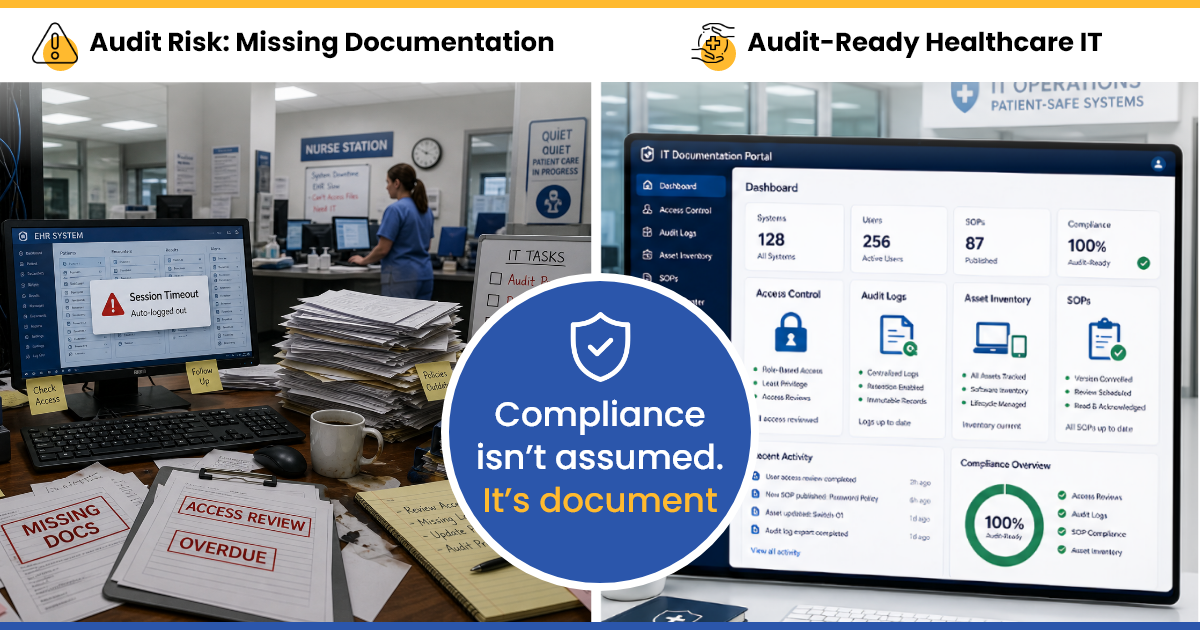
When an auditor asks "who has access to your EHR system?" your answer should be a report, not a conversation.
Audit-Ready Records
The difference between a smooth audit and a stressful one is almost always documentation. Audit-ready records mean:
- System configs are documented at a point in time
- Change logs are maintained automatically
- Access records are current and accurate
- SOPs are version-controlled and up to date
Teams with structured IT documentation for healthcare environments don't prepare for audits, they're already prepared.
SOPs & Process Documentation
SOPs are the backbone of repeatable compliance. When critical IT processes are documented step by step, your team doesn't rely on individual memory or improvisation.
New team members can follow the same process. Auditors can verify that processes are consistent. If something goes wrong, you have a documented baseline to return to.
Healthcare IT Compliance Checklist
Use this checklist as a starting point for building or evaluating your compliance posture:
- Document all IT systems and infrastructure: Servers, endpoints, network devices, applications, and cloud services.
- Maintain an updated asset inventory: With ownership, location, status, and configuration details.
- Implement role-based access control: Map user roles to system access and enforce least privilege.
- Track all administrative access and changes: Log who has credentials to what, and review regularly.
- Create SOPs for critical IT processes: Patch management, onboarding/offboarding, incident response, backups.
- Maintain audit logs and review cycles: Ensure logs are being captured, stored securely, and reviewed on schedule.
- Conduct regular documentation reviews: Set recurring reviews to keep system records and policies current.
- Establish a change management process: Document and approve system changes before implementation.
- Secure and document third-party access: Vendor and contractor credentials require the same oversight as internal access.
- Align documentation with regulatory requirements: Cross-reference HIPAA Security Rule controls with your documentation structure.
How to Simplify Compliance with the Right System
The right platform doesn't just store information; it structures it in a way that makes compliance visible and manageable.
Centralization
Eliminates the scattered documentation problem. When your entire IT knowledge base lives in one organized system, there are no blind spots.
Everything from server configurations to access credentials to SOPs is accessible in one place.
Automation
Reduces manual burden - records stay current automatically as part of normal IT operations, with no more spreadsheets or chasing updates.
Visibility
Gives leadership and auditors a clear view of the IT environment. Dashboards, structured records, and audit trails replace ad-hoc reporting with reliable, on-demand insight.
A structured IT documentation and asset management platform eliminates compliance gaps by bringing everything into one system.
This makes compliance a function of how your team works every day, not something that happens before an audit.
How IT Portal Supports Healthcare IT Compliance
IT Portal is built for IT teams that need more than a place to store documentation. IT Portal helps healthcare IT teams improve documentation governance, operational visibility, and audit preparedness that support broader compliance initiatives.
Centralized IT Documentation
IT Portal's hierarchical structure organizes your entire IT environment in one platform.
Every system, device, and process is documented in a consistent format - searchable, linkable, and always accessible.
Asset Tracking
Maintain a complete, current inventory of hardware, software, and infrastructure.
IT Portal links assets to their configurations, ownership details, and associated documentation, so nothing is undocumented or forgotten.
Secure Credential Management
Track administrative credentials, third-party access, and system logins with controlled visibility.
IT Portal's credential management ensures that sensitive access details are documented, secured, and accessible only to the right people.
Audit-Ready Records
IT Portal's structured documentation helps maintain organized and accessible records for audit preparation.
Configuration records, access logs, SOPs, and change histories are organized and retrievable on demand.
For healthcare IT teams managing complex environments, IT Portal provides the structure that turns good intentions into documented, provable controls.
Conclusion
Healthcare IT compliance is not a project you complete; it's a standard you maintain. Regulations evolve. Auditors look deeper.
Organizations that stay ahead aren't necessarily the ones with the most tools or the largest teams. They're the ones with the clearest, most consistent documentation practices.
Documentation is the foundation. Without it, your security investments, your policies, and your team's expertise remain invisible to the people who need to verify them.
With it, compliance becomes a byproduct of how your IT team operates every day.
The question isn't whether your environment is compliant. The question is whether you can prove it.
Ready to Make Your Healthcare IT Environment Audit-Ready?
Compliance shouldn't be a fire drill. IT Portal helps healthcare IT teams build the structured documentation foundation that makes audits manageable and compliance ready.
Healthcare IT compliance becomes 10× more robust when it operates on top of clean, structured IT documentation.