Bad Data Costs the U.S. $3.1 Trillion Per Year (Harvard Business Review)! That's the staggering annual cost of poor documentation to businesses worldwide. Yet most organizations still struggle with missing governance, no clear ROI measurement, and weak compliance integration.
This guide gives you a practical, step-by-step framework using proven IT documentation best practices to move from scattered notes to strategic, audit-ready, AI-enhanced documentation in just 90 days. You'll learn exactly what top-performing IT teams and MSPs do to reduce risk, prove ROI, and prepare for AI automation.
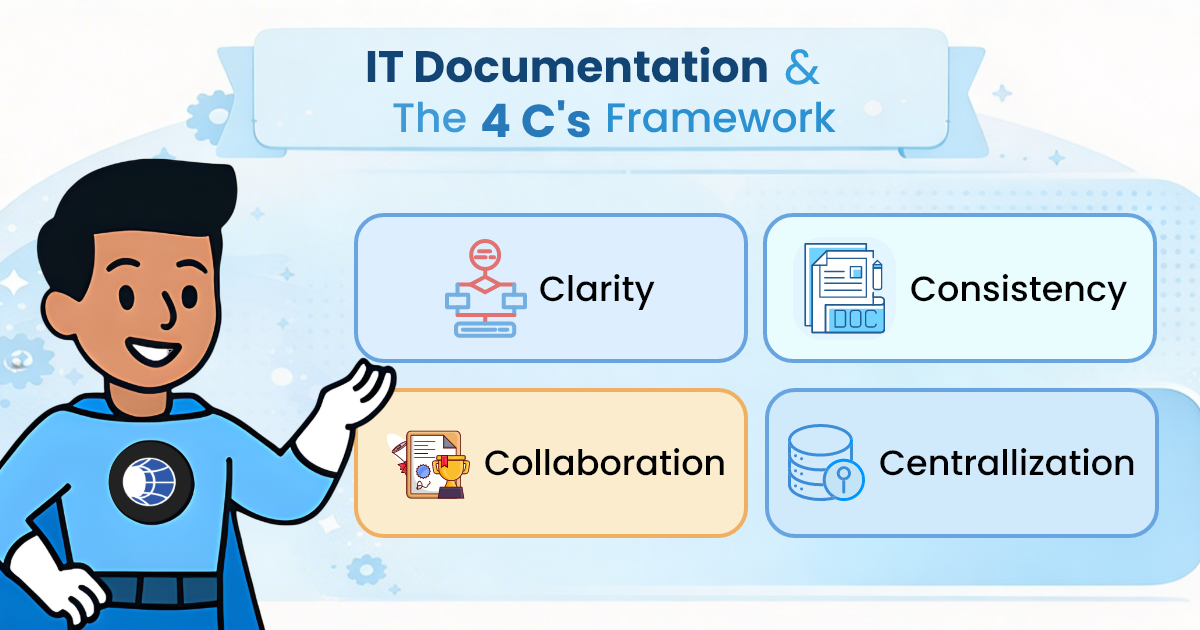
1. Foundation: Types of IT Documentation & The "4 C's" Framework
Effective IT documentation falls into three core types:
- Reference Documentation: Asset/devices inventories, configurations, passwords, network diagrams, vendor contacts
- Process Documentation (SOPs): Incident response, change management, troubleshooting, escalation protocols
- Tutorial Documentation: Training materials, how-to guides, skill-building content, onboarding resources
To make any of these actually usable, follow the 4 C's Framework that consistently delivers results:
- Clarity: Architecture diagrams, flowcharts, annotated screenshots, and short videos help teams comprehend information significantly faster than text-only documentation.
- Consistency: Standardized templates, style guides, naming conventions, and version control eliminate confusion.
- Collaboration: Executive sponsorship, documentation champions, gamification, and protected time (15% rule) keep everyone involved.
- Centralization: A single source of truth with enterprise search, granular access control, audit trails, and integration APIs consistently drives measurable efficiency gains across IT teams.
IT documentation best practices start here - with the right foundation.
2. Best Practices for the IT Documentation Process
Applying IT documentation best practices to your daily process requires four disciplines: planning, execution, maintenance, and quality assurance.
Planning
Begin with a stakeholder analysis, a full documentation audit, gap identification, and a prioritization matrix scored by criticality, compliance requirements, and business impact. Don't try to document everything at once - identify the ten processes where undocumented failure would hurt you most and start there.
Execution
Assign clear RACI (Responsible, Accountable, Consulted, and Informed) ownership for every document: who is Responsible for writing it, who is Accountable for its accuracy, who needs to be Consulted during updates, and who needs to be Informed when it changes. Protect 15% of team time for documentation work, run peer review workflows before publishing, and integrate visual assets wherever they reduce ambiguity.
Maintenance
Documentation debt - the growing gap between how work is actually performed and how it is recorded - compounds silently. Implement automated staleness detection so documents that haven't been reviewed in 90 days surface automatically. Enforce version control on every update. Schedule quarterly retrospectives specifically to review documentation coverage and accuracy.
Quality Assurance
Validate accuracy through real execution testing, not just editorial review. Automate link testing so broken references are caught before they matter during an incident. Collect regular user feedback from the technicians who use documentation under pressure - they will identify gaps that reviewers never see.
Metrics that matter
Track coverage percentage (systems documented vs. total systems), accuracy rate, average search-to-resolution time, and onboarding duration. These four metrics give you a complete picture of documentation health.
3. The Five-Level Documentation Maturity Model
Understanding where your team stands is the first step in implementing IT documentation best practices at scale.
- Level 1 - Ad Hoc: Reactive, scattered files, no standards, single points of failure.
- Level 2 - Managed: Clear RACI ownership, templates, centralized platform, consistent naming conventions.
- Level 3 - Standardized: Style guides, process integration, QA protocols, visual standards.
- Level 4 - Measured: KPIs, ROI tracking, documentation debt management, clear business impact metrics.
- Level 5 - Optimized: AI generation, predictive maintenance, personalized delivery, full automation.
Most organizations sit between Level 2 and 3. Reaching Level 4 usually delivers the biggest ROI.
4. Documentation Governance Framework
Governance is what makes IT documentation best practices stick long-term rather than fading after the initial initiative.
- Steering committee with clear RACI matrix.
- Policy framework covering standards, retention periods, and access rules.
- Compliance integration for SOC 2, ISO 27001, GDPR, and HIPAA with traceability matrix.
- Change management process where documentation updates are triggered automatically with every approved change.
5. Measuring Documentation ROI & Business Impact
Track these four KPI categories:
- Coverage metrics: Systems documented vs. total systems.
- Quality metrics: Accuracy rate and user satisfaction scores.
- Efficiency metrics: Search time and creation velocity.
- Business impact: Onboarding time (typically -40%), support costs (-42%), compliance audit prep time (-60%).
The ROI Formula, Applied Step by Step:
[(Time Saved x Hourly Rate x Team Size) - Platform & Maintenance Costs] / Costs
Here's how to apply it with real numbers. Start with your current average resolution time for documented vs. undocumented incidents. If your team of 10 technicians earns an average of $45/hour, and mature documentation saves each technician 5 hours per week in search time and rework, that's $45 x 5 x 10 = $2,250 per week, or $117,000 per year in recovered productivity. Subtract your platform and maintenance costs. Divide by those costs to get your ROI multiple.
Real-world benchmark:
A mid-sized MSP invested $250K over 12 months in documentation infrastructure, tooling, and dedicated time. They achieved $890K in measurable returns through faster incident resolution, reduced onboarding costs, and eliminated audit preparation overtime - a 256% ROI. Plug your own numbers into the formula above and you'll find the business case for documentation is rarely close.
6. AI-Powered Documentation Lifecycle
Intelligent Generation
Auto-generate docstrings from code, capture workflows automatically, create API documentation, and produce AI-generated diagrams.
Smart Maintenance
Use ML for predictive staleness detection, automated relationship mapping, and quality validation.
Implementation Roadmap
- Months 1-3: Foundation
- Months 4-6: Automation layer
- Months 7-12: Intelligence layer
Note: IT documentation best practices in 2026 treat AI as a core capability.

7. Cross-Functional Documentation Strategy
Tailor content for different audiences:
- Executives -> High-level architecture and dashboards
- Technical teams -> Detailed SOPs and API docs
- Business users -> Simple guides and FAQs
- Compliance teams -> Policies and full audit trails
Remote-first teams benefit from asynchronous standards and a strong centralized hub.
8. Creating Robust Documentation Using IT Portal
Phase 1 - Foundation (Weeks 1-4)
Deploy the platform, build custom asset layouts, set up permission structures, and migrate from scattered tools. IT Portal's hierarchical structure (Companies -> Sites -> Devices/Users) mirrors how your organization actually works.
Phase 2 - Integration (Weeks 5-8)
Import SOP templates, connect PSA/RMM/ITSM systems, enable automated asset discovery, and build your visual repository.
Phase 3 - Optimization (Weeks 9-12)
Activate advanced search, analytics dashboards, compliance mapping, and audit-ready reporting.
IT documentation best practices become effortless when you have the right platform. IT Portal delivers a unified documentation system with automated updates, role-based access, and deep integration ecosystem, reducing tool sprawl by up to 60%.
Key Takeaways
IT documentation best practices come down to five actions: master the three core documentation types, implement the 4 C's framework, leverage IT Portal as your central platform, measure ROI continuously, and scale with AI.
Ready to find out where your team sits on the maturity model?
Take our free IT Documentation Maturity Assessment - 12 diagnostic questions that place you on the five-level model and generate a personalized 90-day improvement roadmap based on your current state.