Your next client just signed a $120K annual contract. Three months later, they're gone.
The problem isn't your technical skills. It's your MSP onboarding checklist.
Here's what 2,000+ MSPs learned the hard way: Traditional task-based onboarding checklists create a dangerous illusion of progress. You check boxes - deploy RMM, configure backups, hand over credentials - but miss the inherited risks lurking in their infrastructure. The result? Support tickets spike 300% in the first 60 days. Trust erodes before you can prove value. And nearly a quarter (23%) of SMEs that leave MSPs cite poor service experience during those critical early months.
But here's what top-performing MSPs do differently: They flip the script with a risk-first MSP onboarding checklist that identifies problems before they become emergencies, proves ROI within 30 days, and turns onboarding from a cost center into a retention engine.
This guide hands you a battle-tested 6-phase MSP onboarding checklist that's proven to cut onboarding time by 30% while reducing Day-90 support tickets by 74%. By the end, you'll have specific implementation steps, validation criteria, and automation strategies to make your next onboarding feel like a competitive advantage.
What Is an MSP Onboarding Checklist? (And Why Most Get It Wrong)
An MSP onboarding checklist is a structured framework for systematically integrating new managed services clients into your service delivery operations. It encompasses everything from initial discovery through the critical first 90 days - when clients are most likely to churn.
But here's where most managed services onboarding checklists fail: They focus on task completion rather than risk mitigation and outcome achievement.
The Traditional MSP Client Onboarding Checklist Looks Like This:
- Deploy RMM agents
- Configure backups
- Set up monitoring
- Document passwords
- Enable antivirus
- Hand off to NOC
Problem: All tasks can be "complete" while critical vulnerabilities remain unidentified, baselines go unmeasured, and clients feel abandoned post-launch.
A Comprehensive MSP Onboarding Checklist Should Accomplish Three Things:
- Identify inherited infrastructure risks before they trigger emergency escalations
- Establish baseline metrics that prove ROI during your first Quarterly Business Review
- Create documented accountability that survives the transition from onboarding to steady-state operations
According to McKinsey research on corporate client onboarding, organizations with optimized onboarding processes experience faster time-to-value, higher retention rates, and more predictable revenue recognition. The average MSP spends 40-80 hours onboarding each client, but those using automation and risk-first frameworks reduce this by 20-30% while improving accuracy.

Why Task-Based MSP Onboarding Checklists Are Quietly Destroying Your MSP
Let's be blunt: Most onboarding checklists for MSPs treat client integration like an IT deployment project rather than a relationship-building opportunity. They focus on checking off technical tasks while missing the business outcomes that actually matter to clients.
The Hidden Cost of Task-Based Thinking
Scenario:
A mid-market MSP signs a manufacturing client with 85 endpoints. They follow their standard client onboarding checklist for MSPs: deploy RMM agents, configure backups, and implement their security stack. Everything checks out technically.
Day 14: Onboarding "complete".
Day 45: Client discovers an unpatched Exchange server they inherited—one you didn't identify during onboarding. Security incident. Emergency response. The client blames you despite inheriting the problem.
Day 60: Support tickets have tripled from your baseline. Your NOC is underwater. The client questions whether switching to you was a mistake.
Day 90: Contract at risk. You're playing defense instead of presenting upsell opportunities.
The financial damage: Lost $120K annual contract + $15K acquisition cost + 60 hours of emergency response labor = $135K in hard costs, plus reputational damage you can't quantify.
Critical Failures of Traditional MSP Client Onboarding Checklists
-
No Risk Discovery You deploy technical solutions without mapping the inherited security posture, compliance gaps, or infrastructure debt. When a breach happens, clients don't care that the vulnerability pre-dated your engagement - they blame their current MSP.
-
Missing Outcome Measurement Task-based checklists track completion, not impact. "RMM deployed" tells you nothing about whether incident response times improved, backup success rates increased, or security posture strengthened.
-
Premature Handoff Most MSPs consider onboarding "complete" at go-live, precisely when clients need the most support. The first 90 days are when baseline behaviors stabilize, edge cases emerge, and trust is either built or broken.
Task-Based vs. Outcome-Based MSP Onboarding: The Real Difference
| Task-Based Approach | Risk-First MSP Onboarding Checklist |
|---|---|
| Deploy RMM agents (95% success) | Achieve 99.5% uptime in first 60 days |
| Configure backups | Validate backup recovery in <4 hours |
| Enable MFA | Reduce unauthorized access attempts 87% |
| Complete documentation | Resolve 80% of Tier 1 issues via self-service portal |
| Hand off to NOC | Reduce support tickets 40% by Day 60 |
The bottom line: Task completion creates a false sense of security. Outcome achievement creates measurable client value.
How a Streamlined MSP Onboarding Checklist Drives Growth
A risk-first managed services onboarding checklist directly impacts your bottom line through three channels:
1. Faster Revenue Recognition
Time-to-revenue matters. The longer onboarding takes, the slower you book recurring revenue and the higher your CAC payback period. MSPs using automation and zero-touch provisioning recognize revenue 20-30% faster than those using manual processes.
2. Early Churn Prevention
Research shows clients form their long-term opinion of your MSP during the first 90 days. A structured, transparent onboarding checklist for MSPs:
- Reduces Day-90 churn risk by up to 40%
- Increases Net Promoter Score (NPS) by an average of 23 points
- Creates 2.5x more upsell opportunities during Year 1
3. Operational Efficiency at Scale
A documented, repeatable MSP client onboarding checklist eliminates knowledge gaps when onboarding team members change, ensures compliance standards are consistently met, and establishes performance baselines that make QBRs more strategic.
6-Phase MSP Onboarding Checklist:
This comprehensive onboarding checklist prioritizes discovering and mitigating risks before they become emergencies while proving value faster than traditional approaches.
Phase 1: Pre-Onboarding Discovery (Days 1-5)
Map infrastructure, identify security gaps, and document Top 5 inherited risks. Complete network topology, scan for unpatched systems, assess backup viability, and understand business-critical systems. IT Portal's auto-discovery reduces mapping time from 12 hours to under 4 hours.
Phase 2: Governance & SLA Alignment (Days 3-7)
Establish clear expectations and escalation paths. Define response times by priority (P1: 15 min, P2: 1 hour, P3: 4 hours, P4: next business day), create RACI matrix, and document change management protocols. Secure signed SLA with executive sponsor.
Phase 3: Secure Technical Setup (Days 5-14)
Deploy core protection in priority sequence:
- Week 1: MFA for admin accounts, endpoint protection (EDR), automated backups with tested restores
- Week 2: RMM deployment, patch management, network security hardening
Why: 81% of breaches involve compromised credentials; 60% of attack vectors are unpatched systems.
Phase 4: Value Baseline Documentation (Days 12-15)
Establish Day Zero metrics across incident response times, vulnerability counts, uptime percentage, and operational costs. Create a baseline report to prove ROI at your first QBR.
Phase 5: Validation & Testing (Days 14-16)
Test disaster recovery, security controls, monitoring alerts, and change management workflows before go-live. Never skip DR testing - discover backup gaps during controlled testing, not during ransomware incidents.
Phase 6: 30-60-90 Day Optimization (Days 17-90)
30-Day: Address early issues, deliver quick wins
60-Day: Present QBR showing measurable improvement from baseline
90-Day: Align technology roadmap with business goals, transition to steady-state delivery
Prove value: "We've reduced incident response time 84% - from 4.2 hours to 45 minutes."
How IT Portal Accelerates Your MSP Onboarding Checklist
IT Portal isn't just documentation software - it's specifically designed to enable the risk-first MSP onboarding checklist that top-performing MSPs use. Since 2007, over 2,000 MSPs have used IT Portal to streamline their managed services onboarding checklist:
Phase 1 Acceleration: Automated Discovery
- Auto-discovery & AI-driven intelligence automatically populates networks, sites, and devices while flagging inherited risks without manual mapping
- Reduces discovery time by up to 30% compared to manual documentation approaches
- Hierarchical multi-tenant setup mirrors real client structures for accurate asset tracking from Day 1
Phase 2-3 Integration: Streamlined Deployment
- Zero-touch provisioning integrates with leading RMM platforms to accelerate agent deployment
- Password vaults and asset inventory templates ensure consistent, secure setups across all clients
- PSA/RMM integrations sync questionnaire data and eliminate manual data entry
Phase 4 Foundation: Baseline Documentation
- Synopsis View dashboard provides instant visibility into risk levels and asset expiration dates
- Automated reporting captures baseline metrics without manual data collection
- Custom fields and templates enable tracking of client-specific KPIs
Phase 5-6 Support: Ongoing Tracking
- 30-60-90 day tracking built into platform for post-launch accountability
- Integration with ticketing systems enables automatic documentation of issue resolution
- Client portal access allows transparent collaboration during stabilization period
IT Portal offers both cloud and on-premises deployment options, ensuring flexibility for your team's security requirements. With transparent pricing, robust support, and proven scalability across 2,000+ MSPs, IT Portal ensures your onboarding checklist is streamlined, efficient, and secure.
Downloadable MSP Onboarding Checklist: Implementation Guide
Ready to transform your MSP client onboarding checklist from a risk liability into a competitive advantage? Here's your action plan:
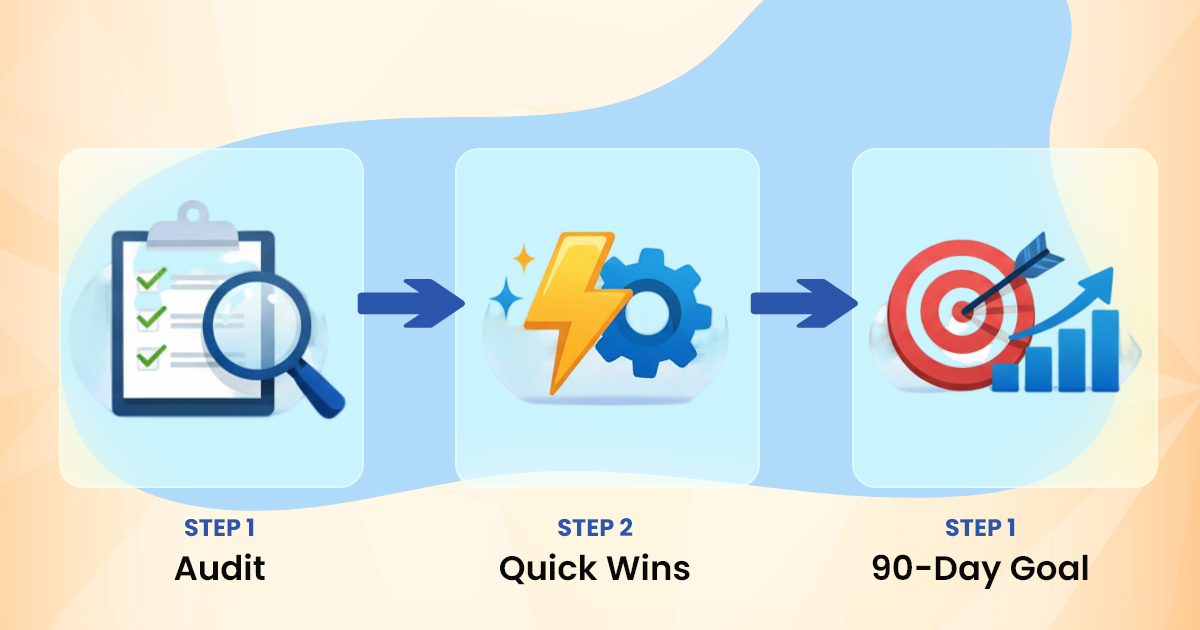
Step 1: Audit Your Current MSP Onboarding Checklist (Week 1)
- Document your existing onboarding workflow
- Compare against the 6-phase framework above
- Identify your top 3 gaps (most MSPs find they lack: risk discovery, baseline metrics, and post-launch accountability)
- Calculate current onboarding costs (hours × hourly rate + tools)
Step 2: Implement Quick Wins (Week 2-3)
- Immediate action: Create a pre-onboarding discovery questionnaire that captures infrastructure details before technical deployment
- Quick win: Add vulnerability scanning to your Day 1 activities - even basic scanning reveals 80% of critical risks
- Process improvement: Schedule automatic 30/60/90-day review meetings when contracts are signed
Step 3: Set Your 90-Day Goal (Ongoing)
- Pick your next new client to pilot the full framework
- Establish KPI baselines during Phase 4
- Track and document results through Day 90
- Use this case study to win your next prospect: "Here's how we reduced our last client's incident response time 75% in 90 days"
Pro tip: Don't try to transform every aspect of your onboarding checklist for MSPs simultaneously. Focus on adding risk discovery (Phase 1) and baseline metrics (Phase 4) to your next onboarding. Once you've proven these work, expand to the full framework.
Your MSP Onboarding Checklist Is Your First Impression
Client onboarding is the pivotal moment when relationships are either strengthened or weakened. Traditional task-based MSP onboarding checklists create an illusion of progress while missing the risks, metrics, and engagement patterns that actually drive retention and growth.
The MSPs winning in today's competitive landscape don't treat their client onboarding checklist as an administrative burden - they've weaponized it as a strategic differentiator. By adopting a risk-first, outcome-focused managed services onboarding checklist, you transform onboarding from a cost center into a client retention and revenue growth engine.
The business case is clear:
- 30% reduction in onboarding time through automation
- 74% drop in Day-30 support tickets through proactive risk mitigation
- 40% lower Day-90 churn through structured accountability
- 2.5x more upsell opportunities during Year 1
Ready to upgrade your MSP onboarding checklist?
- Complete 6-phase onboarding checklist with validation criteria
- Pre-onboarding discovery questionnaire template
- Kickoff meeting agenda with talking points
- RACI responsibility matrix template
- Baseline KPI tracking spreadsheet
- 30-60-90 day review presentation templates
Book a personalized IT Portal demo to see how automation accelerates every phase of your MSP client onboarding checklist - and reduces your onboarding costs by 30% while improving quality.
Get started with IT Portal today - 30-day money-back guarantee
Frequently Asked Questions About MSP Onboarding Checklists
Most MSPs complete technical deployment (Phases 1-5 of the onboarding checklist) in 14-16 days, then maintain heightened engagement through Day 90. While this seems longer than "deploy and forget" approaches, clients achieve stability faster, resulting in 40% fewer support hours during months 2-3.
Task-based checklists focus on completing activities ("Deploy RMM - Done"). Risk-first MSP onboarding checklists focus on outcomes ("Reduce incident response time 75% - Achieved"). The latter prevents emergencies and proves measurable value.
Yes, though you'll spend more time on manual documentation and data collection. The framework itself is platform-agnostic. Tools like IT Portal simply accelerate the process through automation and integration.
Small business checklists can complete Phases 1-3 in 7-10 days with fewer complexity layers. Enterprise checklists require 14-21 days for technical deployment due to multiple locations, compliance requirements, and change management complexity. Both should include the full 90-day accountability period.
Review your MSP onboarding checklist quarterly. Add new security controls as threats evolve, incorporate lessons learned from recent onboardings, and update based on new tool capabilities. Document what worked and what didn't after each client onboarding.
About IT Portal: Since 2007, IT Portal has helped over 2,000 MSPs streamline their client onboarding checklist, improve documentation, and prove measurable value to clients. Learn more at www.itportal.com.